You've probably been there before. You spend six hours staring at a textbook, highlighting every other sentence until the page looks like a neon yellow crime scene. You take the exam, pass it, and then forty-eight hours later, that information has completely vanished from your brain. It feels like you never even walked into the classroom.
This isn't a "you" problem. It's a method problem. Most of us were never actually taught how to learn. We were just told to study. In the high-stakes environment of 2026, relying on passive review is a recipe for burnout and mediocre results.
There is a massive difference between short-term recall and genuine retention. Recall is what lets you parrot back a definition for a quiz. Retention is what allows you to actually apply that knowledge in your career three years from now. If you want to move from just getting by to actually mastering your field, you need to shift toward active learning approaches.
Active Recall
The single most effective thing you can do to improve your grades is to stop reading your notes. I know that sounds counterintuitive. But when you just read and re-read, you're building "fluency," which is the false sense that you know the material just because it looks familiar.
To actually learn, you have to practice pulling information out of your brain rather than trying to shove it in. This is called active recall, or retrieval practice. It works because the act of searching your memory strengthens the neural pathways associated with that information.
Recent data from 2025 shows that students using active recall are 1.5 times less likely to fail than those who stick to traditional lectures and reading.¹ So how do you actually do it?
- Brain Dumping: After you finish a chapter, close the book. Take a blank sheet of paper and write down every single thing you remember. Don't look at your notes until you're absolutely stuck.
- Self-Quizzing: Instead of writing summaries, write questions for yourself. If you're studying biology, don't write "Mitochondria is the powerhouse of the cell." Write "What is the primary function of the mitochondria?" and answer it later.
- Digital Flashcards: Tools like Anki or Quizlet are great, but the key is the effort. If a card is too easy, it isn't doing much. You want that slight feeling of mental strain. That's the sound of your brain actually growing.
Spaced Repetition
If active recall is the "how" of studying, spaced repetition is the "when." Your brain is designed to forget things that don't seem important. This is known as the forgetting curve. If you learn something today, you'll forget about 70% of it within twenty-four hours unless you review it.
Cramming is the ultimate enemy of long-term success. Sure, you might pass the test tomorrow morning, but that knowledge won't stick. A meta-analysis from late 2025 found that combining spaced repetition with active learning has a massive impact on performance, specifically for complex fields like medicine and engineering.
The goal is to review the material just as you're about to forget it. You might review a new concept one day after learning it, then three days later, then a week later, and then a month later. By spacing it out, you tell your brain that this information is worth keeping.
Many students in 2026 are using AI-driven scheduling tools to handle this for them. These apps track which concepts you struggle with and show them to you more often. Research suggests these adaptive environments can increase your learning efficiency by about 30%. It's about studying smarter, not just longer.
Elaboration and Connection
Have you ever noticed how much easier it is to remember a story than a list of random facts? That's because our brains crave context. You can't just collect facts like they're stamps. You have to weave them into a web of things you already know.
One of the best ways to do this is through elaborative interrogation. This is just a fancy way of saying you should ask "why" and "how" constantly.² When you learn a new fact, don't just accept it. Ask why it's true. Ask how it relates to the chapter you read last week.
Then there is the Feynman Technique. It's named after the physicist Richard Feynman, and it's dead simple. Try to explain a concept to a five-year-old (or a friend who isn't in your major). If you find yourself using jargon or getting stuck, you've found a gap in your own understanding.
- Analogies: Try to find a real-world comparison for what you're learning. Is a cell membrane like a bouncer at a club? Is an electrical circuit like a water pipe?³
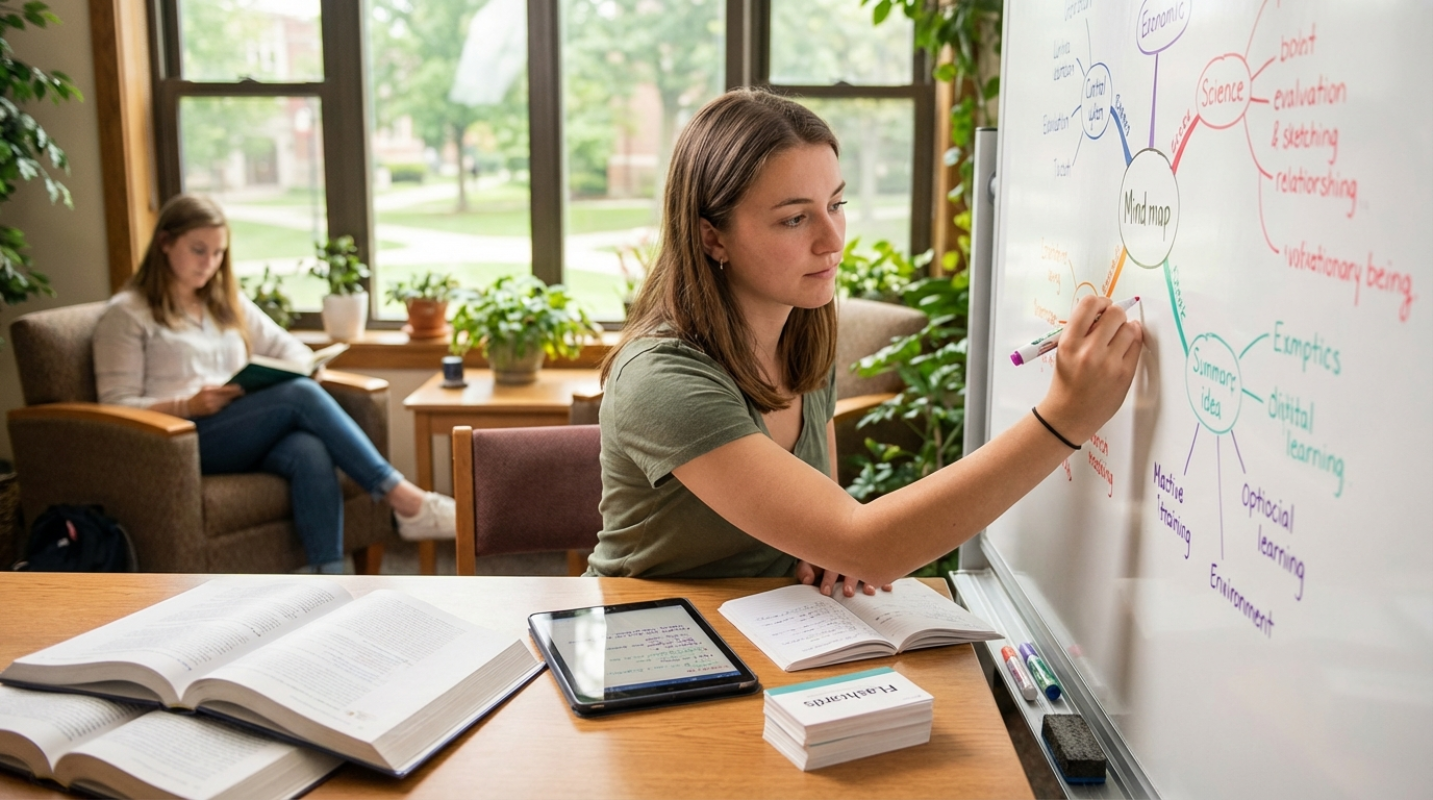
- Dual Coding: Don't just use words. Draw a diagram. Use a timeline. Research from 2025 shows that pairing visuals with verbal explanations reduces your cognitive load and helps you process more info at once.
Optimizing Your Environment
The way you structure your actual study session matters just as much as the techniques you use. One mistake people make is "blocking," which is when you study one subject for four hours straight. It feels productive, but it's actually less effective than "interleaving."
Interleaving is the practice of mixing related subjects in one session. If you have a physics exam and a math exam, spend forty-five minutes on one and then switch to the other. It forces your brain to constantly reset and figure out which approach to use for which problem. This leads to much better problem-solving skills in the long run.
You also need to be honest about your focus. The Pomodoro Technique (working for 25 minutes and then taking a 5-minute break) is still a classic for a reason. It prevents the "zombie mode" that happens when you sit at a desk for three hours without moving.
Finally, we have to talk about the two biggest factors that students often ignore: AI and sleep. A 2025 study found that students who rely on ChatGPT to give them answers without doing the "deep thinking" themselves saw their retention tank within a week. AI is a great tutor, but it's a terrible crutch.
And sleep? A landmark MIT study showed that sleep quality and consistency can account for 25% of your final grade. If you aren't sleeping, you aren't learning. Sleep is when your brain actually moves those short-term memories into long-term storage.